

Carneros Harvest 2026: An Early, Small, and Exceptional Vintage at Coplan Vineyards
By Carole Coplan, Founder & Proprietor, Coplan Vineyards | September 30, 2026
At 6:15 on a cool August morning, our vineyard in the Carneros AVA was nearly silent. Then came the sounds that open every harvest: the snip of picking shears, the rustle of leaves, the thump of empty bins moving down the rows. The barn owls made their last calls as they flew back to their nests, handing the melodic baton to the doves and mockingbirds.
The 2026 Carneros harvest arrived early. It was small and concentrated, and it's bringing back a wine our customers have been asking about for six years. Here's the story of the vintage, from the soil up.
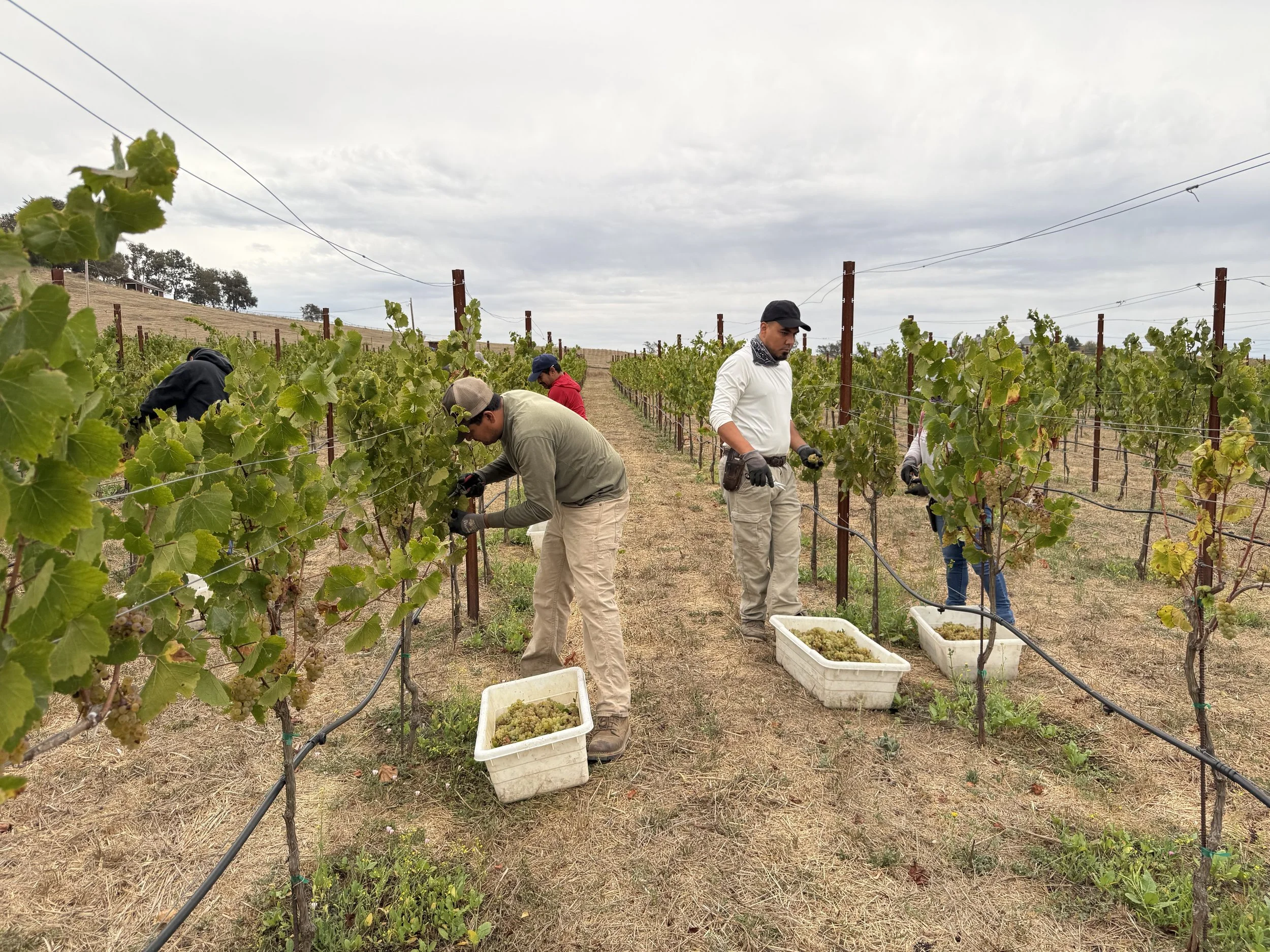
Harvest started before sunrise and ended before the maritime blanket of fog gave way
The 2026 Harvest at a Glance
Chardonnay: Picked August 28, 2026: 2.0 tons
Cabernet Sauvignon: Picked September 16, 2026, for Rosé: 2.0 tons
Season: Early bud break, a crop thinned by spring rain, then a mild summer with a long ripening period
Farming: CCOF Certified Organic, with no synthetic herbicides, pesticides, or fertilizers
Big news: Pivot, our Cabernet Sauvignon Rosé, returns for the first time since 2020
How We Decide When to Harvest Wine Grapes
Harvest looks like one busy morning, but it's really the last move in a year-long game.
Winter pruning sets how much fruit each vine can carry, and its timing can shift the calendar. Prune late, and bud break comes later, a classic hedge against spring frost, which can kill tender new shoots. Flowering brings the next gamble. Cool, wet, or windy weather during bloom can keep blossoms from setting fruit, and they simply fall away. Growers call it shatter. Summer canopy work, like positioning shoots and thinning leaves, controls how much sun and air reach the grapes. Good airflow keeps the clusters dry, which is the first line of defense against mildew in an organic vineyard.
By late August, one question takes over: When do we pick? It's rarely a date that suits our calendar (or my travel schedule). It's the date that suits the grapes.
The answer depends on both the grape and the wine we want to make. Chardonnay destined for sparkling wine is usually the first fruit picked in wine country. Here in Carneros, home to some of California's best-known sparkling wine houses, you can hear the first bins rolling in midsummer. Cabernet Sauvignon for red wine is typically among the last picked, since it needs a long season to ripen fully. This year, we purposely broke our own pattern and picked our Cabernet earlier for Rosé.
For weeks, our winemaker, Jacqueline Yoakum, and I walked the rows. Sugar, measured in Brix, is only part of the answer. We also track acidity, pH, malic acid, potassium, and other chemistry. We check whether the seeds have turned from green to brown and crunchy, and we chew the skins to gauge their flavor and tannins.
Above all, we taste. We test. We ponder. A grape can be chemically ripe and still taste unfinished. The right day comes when the numbers confirm what our mouths already know.
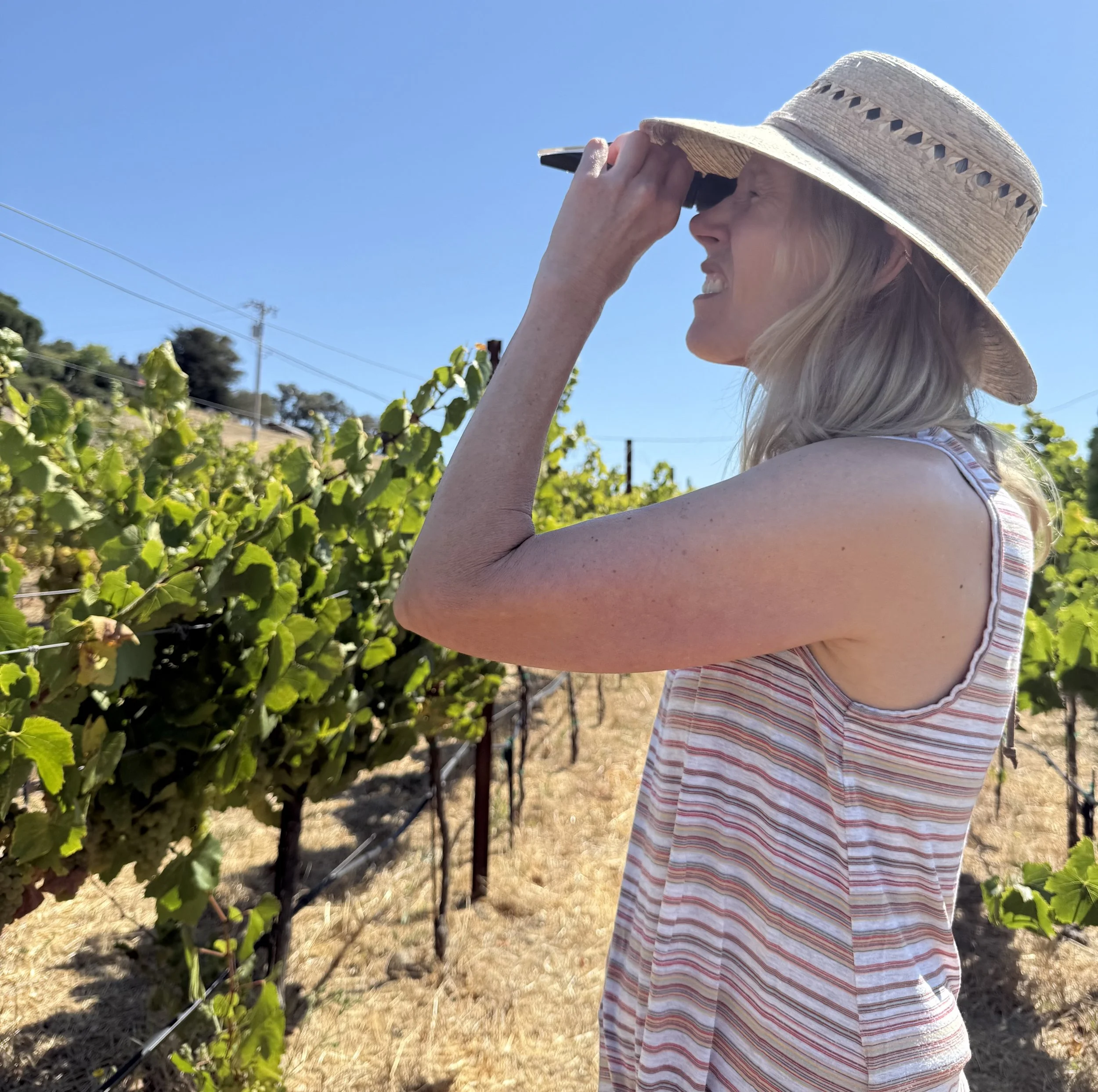
Jacqueline Yoakum, Coplan Vineyards’ winemaker, checking Brix with her refractometer in the Chardonnay block
Why Carneros Makes Distinctive Chardonnay and Cabernet Sauvignon
Carneros sits at the southern tip of both Napa and Sonoma, and it's one of the coolest wine regions in California. Literally.
Most mornings, fog rolls in off San Pablo Bay and tucks the vines in like a cozy blanket. Most afternoons, wind rips through the Petaluma Gap and puts them through a workout. The result? Grapes that ripen slowly, packing in deep flavor while keeping the bright, zippy acidity that makes a wine come alive.
Then there's the dirt, and ours has a story. It's Wright loam: dense, gray, clay-rich soil formed from ancient sea-floor sediments. It hangs onto water like it's been there for millennia (it has), so our vines have to dig deep to get a drink. The vines in our oldest Cabernet block grow on Saint George rootstock, the OG of California rootstocks. Growers swore by it from the 1880s through the 1970s. It shrugged off two waves of phylloxera, the tiny root louse that wiped out vineyards around the world, and today it anchors most of the state's oldest vines.
What does all of that mean in the glass? For Chardonnay, it means citrus, minerality, and freshness. For Cabernet Sauvignon, it means something harder to find: balance.
Here's the plot twist. Carneros is Chardonnay and Pinot Noir country, so Cabernet here is a bit of a rebel. It was a rebel statewide, too, back in the 1940s when our oldest block went in the ground. Those vines have been hand-picked for some 80 harvests, and our vineyard is listed on the Old Vine Registry. Old vines don't give much fruit anymore, but what they do give is pure depth and concentration. Quality over quantity, always.
And I'm bullish on Cabernet's future here. As California's climate warms, I believe cool spots like Carneros will become some of the best places to grow Cabernet Sauvignon and its Bordeaux cousins, letting the grapes ripen fully while keeping their freshness. For us, it's both a hedge against a changing climate and a bet on making exceptional wine for decades to come.
Fog, wind, ancient soil, and old roots. Put them together and you get our terroir: that unmistakable sense of place you can taste in every single glass.The 2026 Growing Season in Sonoma Carneros
Across U.S. West Coast wine country, 2026 made history. Sonoma County Winegrowers reported that the harvest began in what may be the earliest start in the region's history, and that it expected one of the lightest crops in recent years.¹
Our estate followed the same pattern. A warm spring pushed bud break nearly a month early. Then spring rain arrived during flowering and thinned the crop, especially the Chardonnay, which blooms before the Cabernet.
Then the season changed course. Instead of relentless heat, we had a mild summer with only a handful of warm spells, while fog and afternoon breezes kept ripening slow and steady.
Bud break came almost a month early, but the Chardonnay harvest came only eight days earlier than last year. That gap meant extra weeks of hang time, one of the greatest gifts a grower can receive. Fewer grapes, more time, more concentrated flavor.
2026 Harvest in Europe vs. California: Same Calendar, Different Vintage
Europe harvested early too, for very different reasons. Three heatwaves between May and July compressed the growing season across almost every major European appellation, and France recorded its hottest day since records began on June 24.² In Champagne, the official harvest opening dates were the earliest ever observed in the region.³ In Bordeaux, the first grapes for Crémant de Bordeaux were cut on August 6, almost 15 days earlier than in 2025. That opened what officials called the earliest harvest the region has ever seen.⁴
Heat like that races sugar ahead while acidity and flavor can lag behind. In Carneros, an early start gave way to a long, patient ripening.
Coplan Vineyards Harvest Dates and Yields, 2023–2026
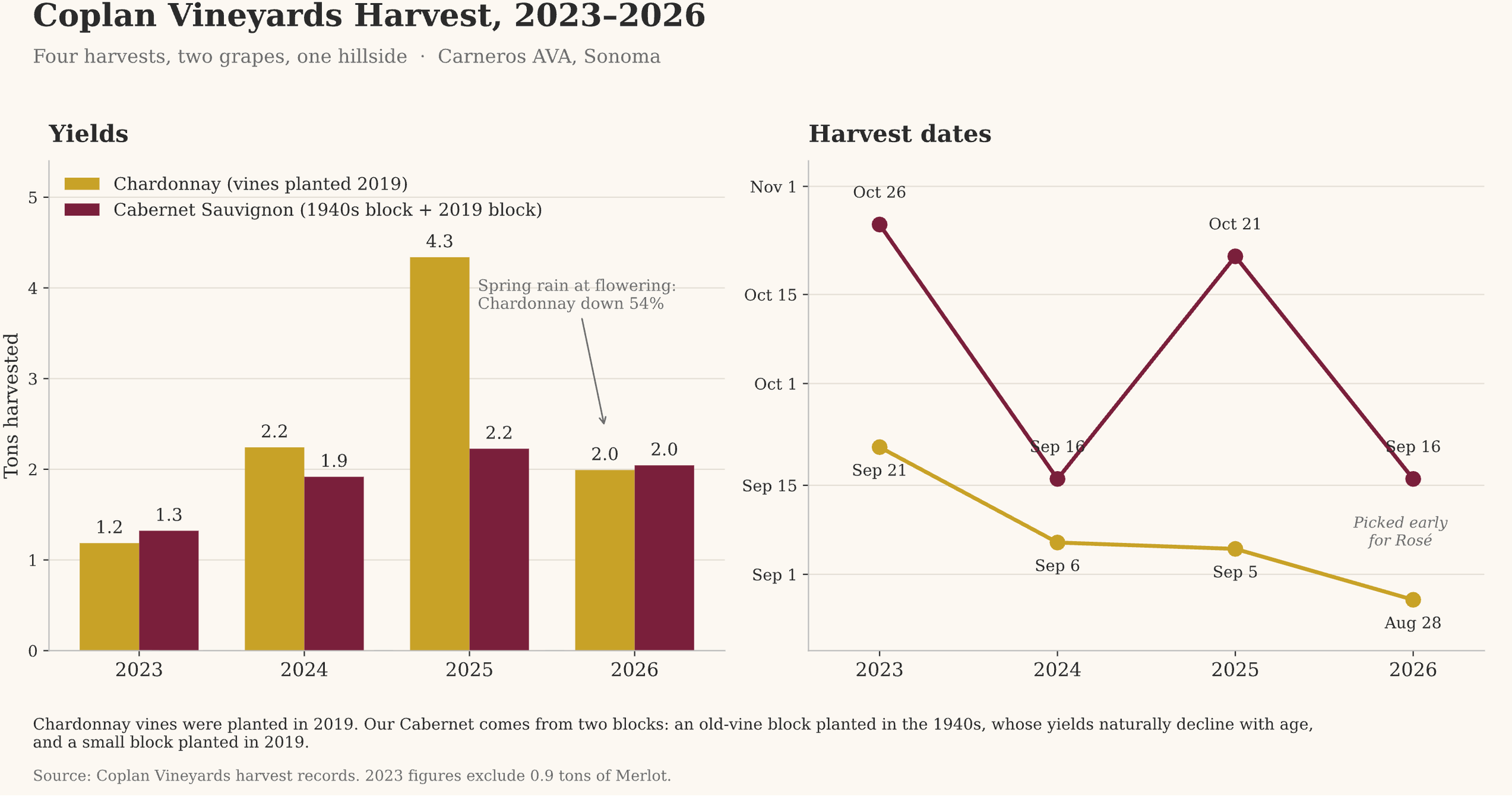
Geeking out with the numbers
Four harvests, two grapes, one vineyard. Our Chardonnay pick date has crept earlier every year, from September 21 in 2023 to August 28 in 2026. After a record 4.3 tons in 2025, spring rain at flowering cut this year's Chardonnay by more than half. The Cabernet, which blooms later, held nearly steady.
Am I worried? Not even a little. Call it a glass-half-full vintage (pun intended). The fruit came in small, intense, and beautifully balanced after weeks of extra hang time, and I'm hopeful 2026 will rank among our finest vintages yet.
The Math of a Small Harvest
In a vineyard, the costs come per acre and per vine, but the wine comes per ton. That's why a light year is felt twice.
Every vine gets the same care whether it carries a heavy crop or a light one. We prune each one by hand in winter, mow and manage the cover crops, and pay the same crew to walk every row. Our 1.3 acres of Chardonnay, about 2,140 vines, cost the same to farm in 2026 as in 2025, but they gave us 3,983 pounds of fruit instead of 8,677. Last year, each vine made about a bottle and a half of wine. This year, it took three vines to make two bottles.
Now for the other side of the ledger. When a vine ripens fewer clusters, it pours all its energy into the ones that remain. Smaller crops tend to mean smaller berries with more skin relative to juice, and the skin is where much of a wine's color, aroma, and flavor lives. Less wine, more character.
For California's wine industry as a whole, a light year may even be a relief. The industry is still working through excess inventory,⁵ and Sonoma County Winegrowers suggested the smaller harvest could help bring supply and demand into better balance.¹
For a small estate like ours, the math is more personal. Demand for our wines already outpaces what we make, and two tons of Chardonnay works out to only about 115 cases. Once it's gone, it's gone.
Pivot Returns: Our 2026 Cabernet Sauvignon Rosé
One of our happiest surprises came out of one of wine country's hardest years.
In 2020, in the middle of the pandemic, wildfire smoke hung over Northern California for weeks during harvest. Rather than lose the vintage, we pivoted and picked our Cabernet Sauvignon for Rosé. Rosé juice is pressed off the skins quickly, which greatly reduces the risk of smoke taint. The wine came out vibrant and beautifully expressive.
We named it Pivot and released it only to our wine club, where it quickly became a favorite. Ever since, one question has come up again and again: "When is Pivot coming back?"
The answer is now.
Many Cabernet rosés are a by-product of red winemaking, made from juice bled off a tank of red. The 2026 Pivot is different: we picked these grapes for Rosé from the start. We harvested early, aiming for fresh strawberry, watermelon, citrus zest, and spring flowers rather than dark black fruit. After just a few hours on the skins, the juice is pressed and fermented like a white wine, which keeps it fresh, delicate, and bright. Stay tuned for a beautiful wine.
What Organic Farming Looks Like in a Carneros Vineyard
Visitors sometimes expect an organic vineyard to look immaculate. Ours doesn't sometimes, and that's the point.
We call it scruffy chic. Grasses and flowering cover crops grow between the rows. Beneficial insects work the leaves, and birds of prey patrol overhead. A living ecosystem protects the vineyard better than bare, sprayed dirt ever could.
In 2026, Coplan Vineyards became CCOF Certified Organic, formal recognition of practices we've followed for years. The certificate is new. The philosophy and our practices aren't: healthy soil grows healthy vines, and healthy vines make more expressive wine… that is also healthier.
Five Things You Might Not Know About the Grape Harvest
We pick in the early morning. Cool grapes arrive at the winery with fresher aromas and less risk of oxidation. We also avoid picking during a heat wave.
A ton of Chardonnay grapes makes roughly 50 cases of wine. That's about 600 bottles, which is why a small harvest makes every bottle count.
Seeds tell time. When they turn from green to brown and crunchy, they're close to ripe.
Rosé color is measured in hours. A red wine soaks on its skins for days or weeks. For Rosé, we pressed the juice off within an hour.
Every vintage happens once. From a single estate, no two years are ever alike. I think this is a good thing.
Coplan Vineyards Wines to Enjoy Now
While the 2026 wines rest in the cellar, here are two favorites to open now.
2024 Owl's Peak Estate Chardonnay
Made entirely from estate vines planted in 2019, after more than seven years of patient site preparation. Elegant, mineral-driven, and beautifully balanced. Pour it with Dungeness crab, roasted halibut, or a wedge of triple crème.
2023 Life of the Party Red Blend
A Bordeaux-style blend of Cabernet Sauvignon and Merlot, made with lower alcohol for easy enjoyment. Bright and fruit-forward. Pour it with wood-fired pizza or grilled salmon, or by the pool. Drink chilled!
Frequently Asked Questions
When is grape harvest in Sonoma?
Harvest in Sonoma County usually runs from August through October. Grapes for sparkling wine and early-ripening varieties like Chardonnay come first, and Cabernet Sauvignon comes last. In 2026, harvest began unusually early across the county.
What is the Carneros AVA?
Carneros is a cool-climate wine region established in 1983 at the southern ends of Napa and Sonoma counties, along San Pablo Bay. Morning fog and afternoon wind make it especially well suited to Chardonnay and Pinot Noir.
What is Cabernet Sauvignon Rosé?
It's a rosé made from Cabernet Sauvignon grapes. The juice spends only a short time on the skins before pressing, which gives it a pale pink color and a fresh, bright style, backed by Cabernet's structure.
Why can lower grape yields mean better wine?
With fewer clusters to ripen, a vine concentrates its energy in the fruit that remains. Smaller berries have more skin relative to juice, and the skins carry much of a wine's color, aroma, and flavor.
Is Coplan Vineyards organic?
Yes. Coplan Vineyards is CCOF Certified Organic and uses no synthetic herbicides, pesticides, or fertilizers.
How much wine does a ton of grapes make?
Roughly 50 cases, or about 600 bottles, depending on the grape and the winemaking style.
Looking Ahead
Harvest is both an ending and a beginning. It closes a season nearly a year in the making and opens the first chapter of wines that won't reach your table for months.
Every bottle starts with mornings like these: cool air, quiet rows, careful decisions, and the hope that we've captured one fleeting season. Thank you for sharing it with us.
— Carole Coplan, Founder & Proprietor, Coplan Vineyards | Carneros, Sonoma
Join our Newsletter (More wine, no spam!)
Sources
Sonoma County Winegrowers, "Sonoma County Begins One of Its Earliest Winegrape Harvests in Years," July 24, 2026. https://sonomawinegrape.org/sonoma-county-begins-one-of-its-earliest-winegrape-harvests-in-years/
WineCap, "Harvest 2026: Europe's Earliest Picking on Record as Heat Reshapes the Vintage," August 15, 2026. https://winecap.com/editorial/news/harvest-2026-europes-earliest-picking-on-record-as-heat-reshapes-the-vintage
Vinetur, "Champagne Will Start Its 2026 Grape Harvest Earlier Than Ever Recorded," August 14, 2026. https://www.vinetur.com/en/amp/20260814105662/champagne-will-start-its-2026-grape-harvest-earlier-than-ever-recorded.html
Vinetur, "Bordeaux Begins Its Earliest Harvest on Record," August 7, 2026. https://www.vinetur.com/en/20260807105394/bordeaux-begins-its-earliest-harvest-on-record.html
Solera, "2026 California Wine Harvest Outlook: Early, Light Crop," August 6, 2026. https://solera.vin/blog/2026-california-wine-harvest-outlook